Why Privacy Problems Are Often Discovered Too Late
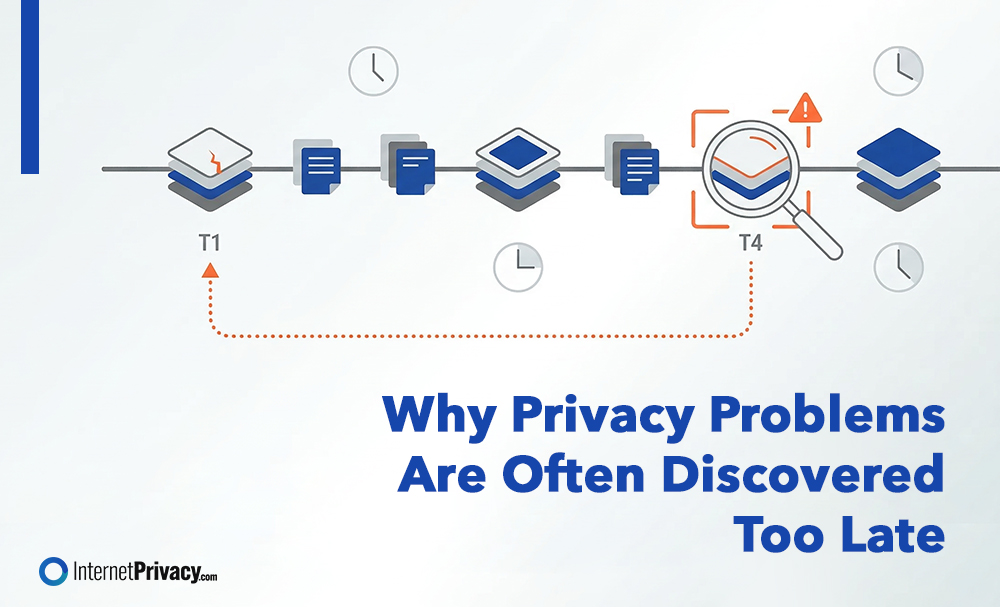
Privacy problems rarely appear all at once. Instead, they build quietly over time, inside systems that were never designed to slow down or look back.
By the time a data breach comes to light, personal data has often been exposed for months. In some cases, it has been exposed for years. At that point, the damage is already done, and affected parties are left reacting rather than preventing it.
This pattern is not random. It is structural.
Privacy Failures Start With Data Accumulation
Most privacy problems begin the same way. Companies collect and retain personal information.
Data collection serves many purposes. Organizations gather data to provide services, improve apps, support marketing campaigns, and enable targeted advertising. Over time, however, those purposes blur.
What remains is vast amounts of personal data stored in cloud systems. Location data, browsing habits, sensitive information, and sometimes biometric data, such as facial recognition, are all aggregated in a single repository.
Each dataset becomes a valuable asset. At the same time, it becomes a growing risk.
Too Much Data Hides Real Problems
As organizations process personal data at scale, visibility into these processes declines.
Large databases make it harder to notice misuse, leaks, or unauthorized access. Ownership becomes unclear, logs stay incomplete, and legacy systems remain connected longer than intended.
Meanwhile, data mining and online tracking continue quietly in the background. Privacy controls often lag behind real-world behavior.
As a result, by the time something looks wrong, it has usually been wrong for quite a while.
Privacy Policies Don’t Help Users See the Risk
Privacy policies are meant to inform users. In practice, they often do the opposite.
Most policies are long and vague, written to limit liability rather than to increase clarity. As a result, users rarely know what data is collected, how it is used, or who receives it.
Because of this lack of transparency, privacy problems stay hidden longer. Users cannot challenge practices they do not understand, and regulators often act only after harm becomes visible.
Among data privacy experts, the general consensus is clear. When users lack insight, risks grow unnoticed.
Human Error Plays a Key Role
Not all privacy problems start with technology.
Undertrained employees misconfigure systems, reuse credentials, or grant overly broad access. Sensitive data gets shared internally without proper safeguards.
Too often, organizations treat employee training on data privacy and information security as optional. Yet human error remains one of the most common causes of data breaches.
Without clear security practices and regular awareness training, small mistakes compound quietly.
Third Parties Expand the Blind Spots
Modern businesses depend on vendors, apps, and analytics tools.
Platforms like Google Analytics, cloud providers, advertising networks, and social media platforms process personal data on behalf of companies. Each integration introduces new privacy risks.
In many cases, companies share personal information with third parties for analytics or advertising purposes. That data may later be sold to data brokers without explicit user consent.
Once data leaves the original system, tracking it becomes difficult. When something goes wrong, accountability becomes unclear.
Privacy Laws React After the Damage
Data protection laws aim to reduce harm, not prevent every failure.
The General Data Protection Regulation serves as the primary data protection law in the European Union. In the United States, laws such as the California Consumer Privacy Act and the Colorado Privacy Act grant consumers more control over personal data.
These laws require a lawful basis for collecting data and mandate transparency. They also impose penalties for non-compliance.
Even so, enforcement usually follows discovery. Audits, investigations, and fines tend to follow a breach rather than precede it.
Compliance Does Not Equal Safety
Many organizations prioritize data privacy compliance over substantive privacy protection.
They appoint a data protection officer, publish policies, and complete required documentation. However, they often fail to reduce data collection or tighten access controls.
Not budgeting enough resources for privacy and security remains common. Privacy teams remain understaffed, tools lag, and monitoring remains limited.
Consequently, compliance frameworks cannot protect data if risky practices remain in place.
Technology Often Makes Detection Harder
New technology introduces new privacy concerns.
Large language models and other AI models depend on massive datasets. When organizations govern those datasets poorly, discrimination, misuse, or unauthorized exposure can follow.
At the same time, connected devices collect constant streams of data. Many IoT devices track real-time location data, yet most cannot run antivirus software or generate reliable logs.
Weak security measures in these devices create blind spots that attackers exploit quietly.
Why Breaches Stay Undetected for So Long
Privacy problems often go unnoticed because warning signs are subtle.
Attackers rely on stolen credentials and move slowly. Bad actors avoid triggering alerts. Data leaks also occur through internal mismanagement or improper disposal of hardware.
Without visibility tools, organizations fail to detect exposed credentials or unusual access patterns. Without regular audits, excessive data collection continues unchecked.
By the time teams confirm a breach, identity theft and financial fraud are already underway.
The Psychological Cost Is Real
Privacy failures cause more than technical harm.
Aggressive tracking and constant monitoring change how people behave. Over time, users self-censor and lose trust.
Algorithmic curation and filter bubbles limit exposure to diverse perspectives. Digital footprints enable manipulation, while deepfakes and phishing scams become harder to detect.
Late discovery exacerbates these harms because users had no opportunity to opt out earlier.
What Early Detection Actually Requires
Finding privacy problems sooner requires restraint, not just better tools.
Businesses should collect only the data they need. Data minimization reduces risk immediately.
Data mapping helps organizations understand what personal data they hold and how it moves. Regular audits expose gaps before attackers do.
Strong access controls limit damage when mistakes happen. Backup and recovery plans reduce the impact of human error.
Most importantly, privacy professionals need a seat at the table early, not after incidents occur.
Why This Keeps Happening
Privacy problems are discovered too late because systems reward scale, speed, and monetization.
Collecting data is easy. Storing it is cheap. Protecting it requires discipline.
Until organizations treat privacy and security as core responsibilities rather than compliance tasks, this pattern will continue.
Late discovery is not an anomaly. It is the predictable outcome of how personal data is handled today.