What Happens When Privacy Is Inferred Instead of Violated
Most people think privacy is lost when something private is exposed: a hacked email, a leaked database, or a photo shared without consent.
However, that is no longer the main risk.
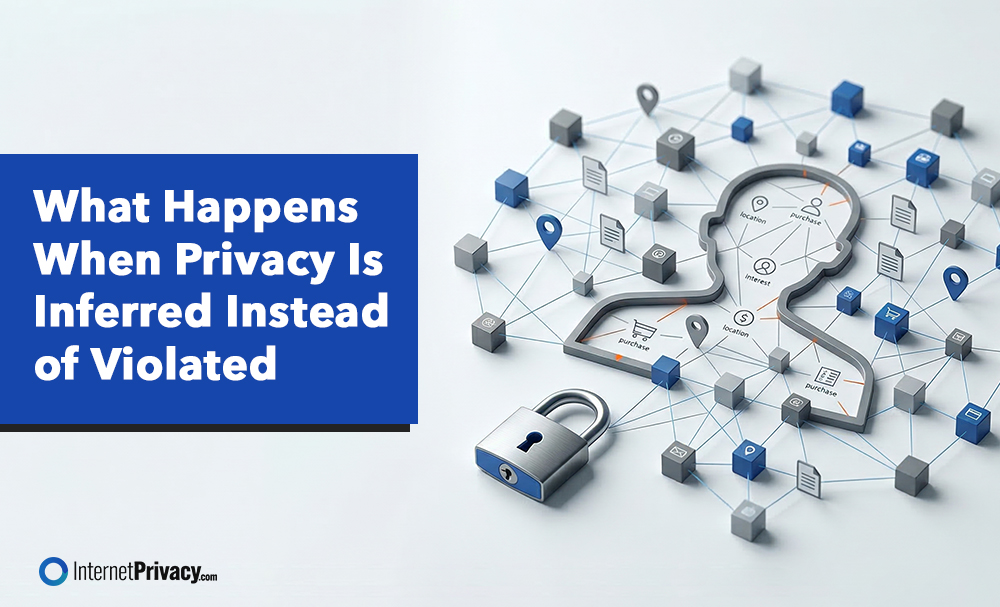
Today, privacy is often inferred rather than violated. No one breaks in. No system is breached. Instead, public actions, usage data, and small signals combine until something sensitive appears anyway.
Nothing is technically stolen.
Yet, such personal data becomes revealed.
The Shift From Exposure to Inference
A privacy violation is obvious when someone accesses personal data they were never supposed to see. Laws are built around this idea. For example, the Fourth Amendment in the United States, the General Data Protection Regulation (GDPR) in the European Economic Area, and similar frameworks worldwide focus on unauthorized access, disclosure, or misuse of personal data.
Privacy inference, however, works differently.
Platforms collect information willingly provided or lawfully collected under applicable law. They process social media activity on social media sites, search queries, location data, including Wi-Fi access points, device information, language preferences, IP address patterns, and other data from third-party websites and online services to analyze data patterns. Each piece looks harmless on its own, but together, they tell a story.
From that story, systems infer things people never explicitly shared: political beliefs, sexual orientation, health concerns, financial stress, and religious affiliation.
No lock is picked.
No rule is clearly broken.
Yet, the outcome feels the same.
How Inference Actually Happens
Most modern online services collect personal data to operate. Search engines log queries. Operating systems gather device information. Payment processors like Stripe collect payment information, transaction data, and bank account details. Platforms like Google, Microsoft, and Salesforce collect such personal data to improve services, detect fraud, and support advertising.
This data collection occurs under contractual and legal obligations and often with explicit user consent.
Automated systems then process this data to analyze patterns.
A location ping near a clinic.
Repeated late-night searches.
Which social media platforms are used.
Which ads you click or ignore.
Data aggregation turns these fragments into profiles—not guesses but probabilities and high-confidence predictions.
Because the data was technically public or collected under “legitimate interests” or public interest, the inference often sits outside traditional definitions of a privacy breach.
Why This Feels Different Psychologically
People react differently to inferred privacy loss because it remains invisible.
There is no notification saying, “Your sexual orientation was inferred.”
No alert stating, “Your financial instability was categorized.”
No warning that an algorithm now treats you as a higher risk.
Instead, the effects show up indirectly: different ads, pricing, content moderation, and opportunities.
Over time, this creates anxiety and self-censorship. People share less, search less freely, and second-guess normal behavior. Privacy stops feeling like control over information and starts feeling like constant exposure.
Marginalized and vulnerable groups feel this most. They often must provide more personal data to access housing, employment, healthcare, or government services, and they experience greater harm when inferences are wrong or biased.
Why Existing Laws Struggle to Address This
Most privacy regulations were written to prevent the collection or disclosure of personal data, not inference.
GDPR grants data subjects the right to request access to, correction of, or deletion of personal data processed about them. The California DELETE Act requires data brokers to honor global deletion requests. Universal opt-out signals must now be respected in many U.S. states. By January 2026, twenty state consumer privacy laws will be in effect.
These are meaningful advances.
However, inferred data often isn’t stored as a clear field, such as “sexual orientation” or “health condition.” Instead, it exists as internal scores, models, and classifications, making it harder to request access, correction, or deletion.
Even the “right to be forgotten” struggles here. Deleting source data may not remove the inference.
The Role of Big Platforms
Companies like Google, Microsoft, Stripe, and Salesforce collect personal data across browsers, devices, apps, and other online services. They use cookies, similar technologies, server logs, and device identifiers to understand behavior.
Much of this is disclosed in privacy policies. Much of it is lawful and done under contractual and legal obligations, often involving data centers located globally.
The problem is not data collection itself.
The problem lies in how much can be derived.
Advertising services, business intelligence tools, and other third parties rely on inferred traits to optimize decisions. Once those inferences exist, they become shared personal data, transferred personal data, or are acted upon across systems.
At that point, privacy loss is no longer tied to a single action. It becomes structural.
What Individuals Can Actually Do
No single setting can fix inferred privacy. However, practical steps reduce exposure:
- Be mindful of what you share on social media platforms.
- Review your Google Account privacy settings and manage activity data.
- Turn off location services when they are not essential.
- Configure browsers to limit cookies or signal tracking preferences.
- Use private browsing modes when appropriate.
- Delete browsing history and cookies periodically.
- Control which apps access your personal data.
- Enable two-factor authentication on all accounts to secure access.
- Manage ad settings to reduce the use of interest-based advertising and marketing communications.
- Keep operating systems, browsers, and apps up to date to address security concerns.
- Avoid unsecured public Wi-Fi or use a VPN with HTTPS connections.
These steps do not eliminate inference but limit the raw material on which inference relies.
Why This Is Becoming a Human Rights Issue
Privacy has always been about more than secrecy. Philosophers from Aristotle to John Locke framed privacy as essential to autonomy and self-expression. Modern human rights law reflects this. The United Nations Universal Declaration of Human Rights protects against arbitrary interference with privacy. Many constitutions worldwide do the same.
As technology evolves, privacy is no longer just bodily or spatial. It is digital. Neural data, biometric data, and behavioral signals are increasingly subject to regulation because they reveal who a person is, not just what they did.
When privacy is inferred instead of violated, the risk is not just exposure. It is a loss of agency.
Where This Is Headed
New regulations are emerging: mandatory age verification, restrictions on data brokers, expanded definitions of sensitive personal data, enforcement of universal opt-out signals, and stronger obligations for data controllers and service providers.
Data controllers responsible for processing personal data will face increased accountability for complying with legal obligations imposed by government authorities.
However, the law will always lag behind capability.
The real question is whether society accepts inference as “fair game” simply because no rule was broken, or whether privacy protections evolve to address outcomes, not just methods.
Once enough can be inferred, the distinction between public and private stops mattering.
That changes what privacy means altogether.