Why Privacy Issues Are Increasingly Linked to Financial Decisions
Privacy used to feel abstract.
Now it affects whether you get approved.
In recent years, financial decisions have become deeply tied to how personal data is collected, stored, and used. Loans, credit limits, fraud alerts, and even basic account access depend on vast amounts of sensitive data moving through complex systems. When privacy breaks down, the consequences are no longer theoretical. They are financial.
This shift did not happen overnight. It is the result of excessive data collection, rapid AI development, weak security practices, and privacy laws struggling to keep up with new technology.
Financial Decisions Now Depend on Sensitive Data
Every modern financial decision relies on data.
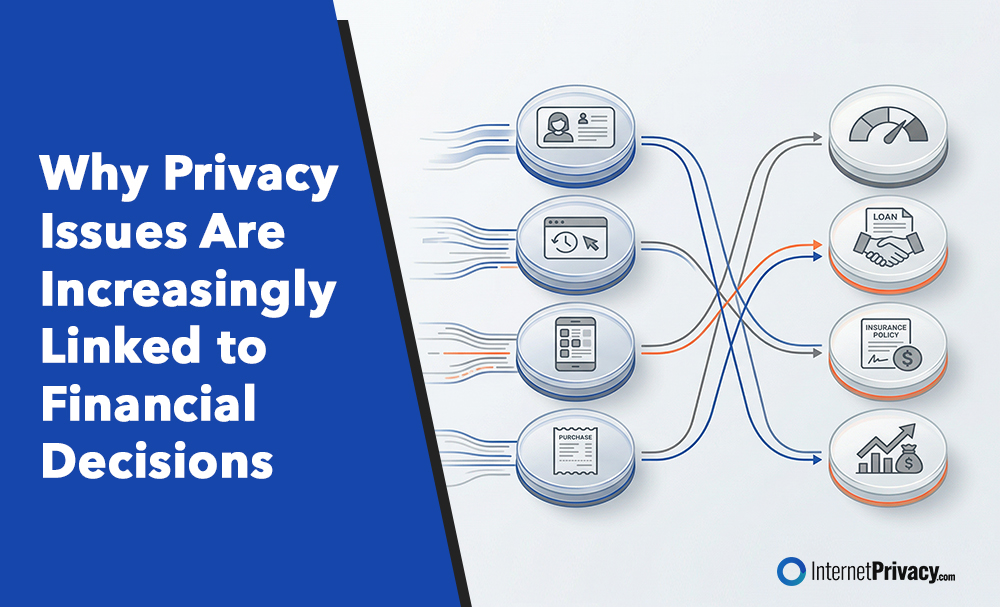
Banks, lenders, insurers, and fintech companies collect personal information to determine risk, verify identity, and detect fraud. This includes sensitive personal information such as:
- financial history
- location and device data
- behavioral patterns
- social connections
- online activity
Much of this data is created passively. It comes from apps, IoT devices, social media platforms, and everyday internet use. In many cases, users are not fully aware of how much data is collected or how it will be used later.
Once collected, this data becomes valuable. And valuable data becomes a target.
Why Privacy Issues Now Directly Affect Outcomes
Privacy issues are no longer limited to reputation damage or inconvenience. They influence real financial outcomes.
Data breaches expose sensitive data and lead to identity theft and financial loss. Over 80 percent of consumers say they may abandon a company after a breach. That loss of trust affects stock prices, partnerships, and lending behavior.
At the individual level, breaches trigger fraud alerts, frozen accounts, denied applications, and long recovery periods. Even when consumers are not at fault, the burden falls on them.
Financial institutions know this. That is why privacy risks now factor into decision models. Systems are designed to limit exposure. And when privacy signals appear weak, access tightens.
The Role of Excessive Data Collection
Many businesses collect far more data than they need.
This creates risk.
Data minimization practices exist for a reason. Collecting only what is necessary reduces exposure, lowers compliance risk, and limits damage if something goes wrong. Regulators are increasingly enforcing this principle.
But AI systems complicate the issue.
AI development often depends on massive amounts of data. The collection-limitation and purpose-specification principles of privacy law are challenged by models trained on large datasets. Data collected for one purpose is often reused for another, a practice known as secondary use.
When data is reused beyond what consumers reasonably expect, privacy concerns escalate. Public trust erodes. And financial decisions become more conservative as institutions attempt to protect themselves.
Artificial Intelligence Raises the Stakes
Artificial intelligence can process vast amounts of data and generate predictions that shape financial outcomes.
That power comes with risk.
AI systems can infer sensitive information that was never explicitly provided, including health status, sexual orientation, or financial stress. This blurs the line between personal data and non-personal data.
AI systems also complicate consent. Most users cannot realistically understand how their data will be used once it enters complex models. This undermines meaningful consent and challenges existing privacy laws.
As AI becomes embedded in fraud detection, credit scoring, and account monitoring, privacy issues move from the margins to the center of financial decision-making.
Social Media and Data Brokerage Complicate Privacy Further
Social media platforms collect vast amounts of personal information. This includes data about users, their friends, and even non-users.
Social media companies track behavior, interests, purchasing habits, private messages, and networks of connections. Much of this data is retained indefinitely and shared through data brokers who aggregate and sell profiles.
These massive datasets are vulnerable. They attract bad actors. Phishing, social engineering, and AI-enhanced scams now use leaked or scraped data to target individuals with precision.
When this data intersects with financial systems, the risk multiplies, and fraud becomes easier. Identity theft becomes faster. And financial institutions respond by increasing scrutiny.
Why Privacy Laws Now Shape Financial Strategy
Data privacy laws are no longer a compliance footnote. They shape business models.
Failure to comply with modern privacy laws can result in fines of up to four percent of global revenue. State attorneys general actively enforce these laws. The FTC Act addresses unfair and deceptive privacy practices. New state laws adopt GDPR-style consent requirements.
At the same time, many businesses struggle to keep up. Privacy laws change often. Resources are limited. Undertrained employees remain one of the most common sources of privacy failures.
Organizations that fail to invest in privacy teams, access controls, and strong security practices often pay far more later through lawsuits, fines, and lost trust.
Financial Decisions Reflect Trust and Control
Consumers increasingly view their data as personal property.
They expect control. They expect transparency. And they expect companies to protect personal information.
When privacy promises are broken, behavior changes. People avoid specific platforms. They hesitate to share data. They choose financial products based on perceived security, not just rates or features.
This is especially true for young people, who are more aware of online privacy risks and more skeptical of excessive data collection.
Financial decisions now reflect trust as much as math.
What Companies Must Do Moving Forward
To remain competitive and compliant, companies must treat privacy as a core financial concern.
That means:
- implementing robust security measures
- limiting data collection to only what is necessary
- enforcing access controls
- training every team member on privacy risks
- aligning data use with reasonable consumer expectations
- conducting regular audits
- building strong relationships with privacy professionals
These practices are not optional. They protect consumer privacy and financial stability simultaneously.
What Individuals Can Do
Individuals are not powerless.
Strong, unique passwords and two-factor authentication reduce risk. Limiting the sharing of information on social media helps. Avoiding public Wi-Fi for financial activity matters.
But systemic issues remain. That is why regulation, transparency, and accountability are essential.
The Core Reality
Privacy issues are increasingly linked to financial decisions because data is now the foundation of finance.
When privacy fails, trust fails.
When trust fails, access tightens.
And when access tightens, financial outcomes change.
This connection will only grow stronger as AI systems expand and data volumes continue to rise.
Understanding that link is no longer optional.
It is part of making informed financial decisions in a data-driven world.